

An Optimistic Pause: Lessons on Publishing from a First-Time Author
Clear-eyed insights from Wendy Schwartz on writing, waiting, and letting the book land


Way back, when I was fresh out of university, I was a bank teller at the National Trust in downtown Ottawa. I wasn’t a particularly good teller, but I loved working with the regulars—the woman so talkative she barely took a breath, the man who looked like he lived on the street despite a huge bank balance, the best-selling fantasy author. One of them, Steve, stopped by once a month. He was some sort of regional manager for the bank, and he showed up always with a smile, nearly bursting with good-naturedness and optimism.
“How do you show up like this every time I see you?” I asked one day. “Don’t you have bad days?”
“Of course,” Steve said. “But I make a choice to be happy. Every day. I choose to be optimistic.”
I was 22, working two part-time jobs, renting a room, and riding the bus. It was exactly the message I needed to hear. I put it into practice. Not perfectly, but I tried.
Fast-forward 28 years…
Wendy wanted accountability. She wanted book coaching to take her over the finish line, and engaged me as her coach. It was summer 2024 and she already had a book plan. It included a fully conceived idea, a structure, a table of contents…and tons of ideas. Her book concept intrigued me, too: Optimism isn’t just a mindset—it’s a practice. It reminded me of Steve. And of myself. This might be a fun project, I thought.
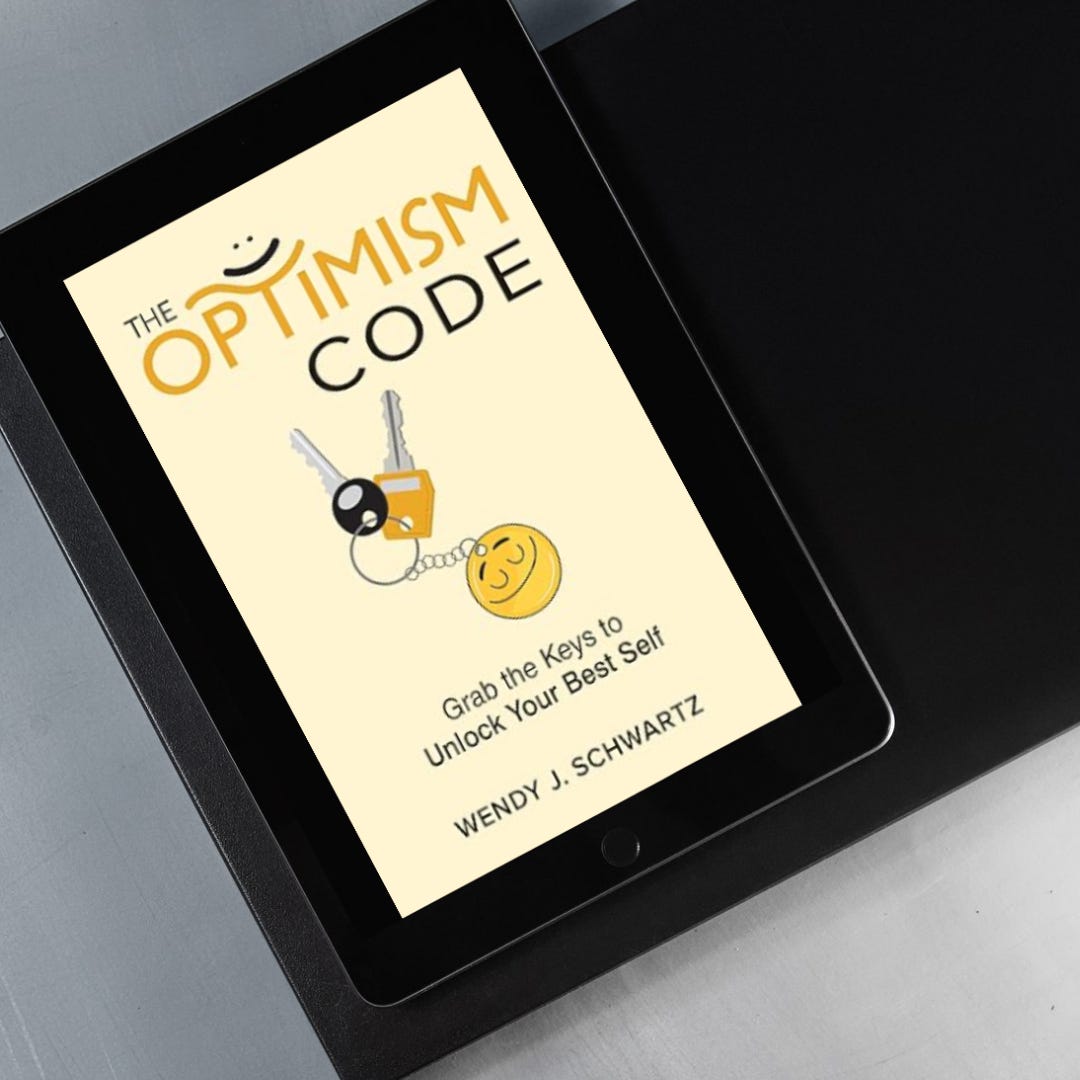
Over the summer, in our biweekly book coaching sessions, Wendy’s book took shape, gained firmer structure, and eventually became a finished book, The Optimism Code: Grab the Keys to Unlock Your Best Self. Last week, I sat down and read it again. In it, Wendy shares stories, advice and exercises to help readers open up space for optimism. I love the chapter titles:
This is Your Brain on Optimism
Living Life in the Present Moment (Even When It Stinks)
The M Word: Let’s Talk About Meditation
Wendy’s voice is the book’s strength, and it comes through with humor and candor. She delivers her lessons with an eye for practicality — because she, too, seeks optimism.
“Finding the good in life doesn’t come naturally to me. Unlike Pollyanna, the fictional character who always sees the best in everything, I adopted optimism because I decided that living a life fraught with anxiety was no fun. It was a pragmatic decision based on the fact that I didn’t want to spend time wallowing in misery.” —Wendy Schwartz
After we ended our coaching arrangement, Wendy moved into the publishing stage, and I wished her well. A few more steps and it would be out in the world.
And then Wendy paused.
“Where’s the book?” I asked her every few months.
“It’s on pause,” she’d say. “I’m not ready to click the ‘publish’ button.”
We’d chat and part ways, and I’d check in again. Finally, earlier this year, she did it: She clicked the ‘publish’ button. I’m thrilled for her. But I wanted to find out more about her experience publishing her first book, so we met again. In our interview below, Wendy reflects on the creative process behind The Optimism Code, the big pause before she published, and what it really feels like to see her name on the cover. If you’ve ever wrestled with self-doubt or wondered whether your book really matters — or if you have a book project on hold right now — I think you’ll find a lot to love in Wendy’s words.

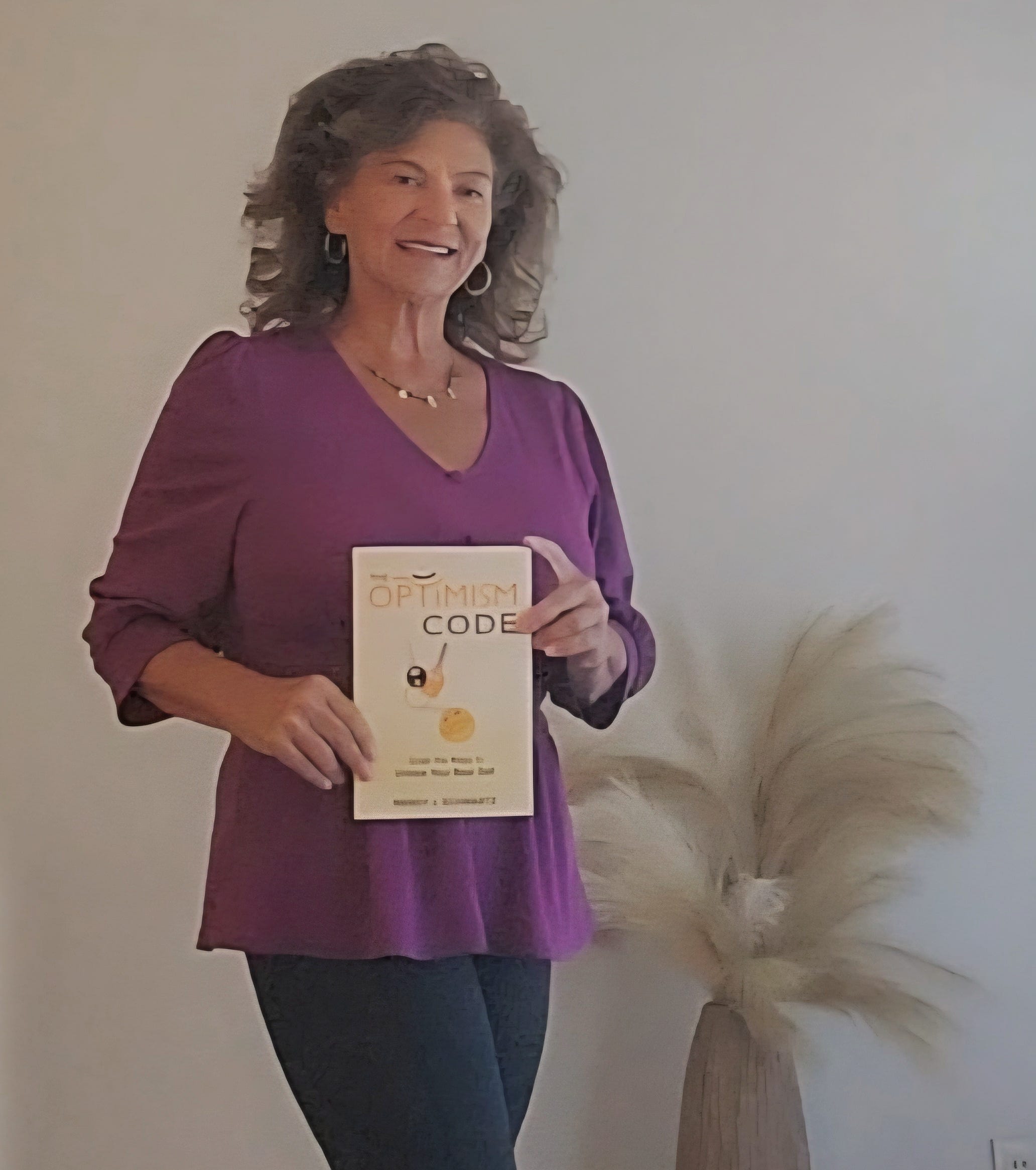
Meet Wendy Schwartz
Author of The Optimism Code: Grab the Keys to Unlock Your Best Self
There was a piece of me that didn’t want to reveal things that I had written…and I wasn’t sure if I was ready for that. It’s a very vulnerable place to be.
Dinah (Interviewer): I really like this book, Wendy. I think it’s a great toolkit. And I think readers will learn a lot from it and come away with some really practical strategies. What’s the core takeaway you most want readers to remember after reading it?
Wendy (Author): One of the reasons why I wrote the book, and the core takeaway, is that it’s not just one technique that works in order to improve your well-being and your mindset. It’s a group of things. I spent pretty much my whole life accumulating a lot of different techniques—my keys to optimism—and then putting them on my own keychain to create a method that works for me personally. Everybody’s unique in what helps them and what doesn’t. So [this book is] an opportunity for people to try out different strategies and then build them into their own personal keychain.
When we were working together in your book coaching sessions, you moved through this first draft really quickly. I was so impressed. How did it feel to you to be able to move that quickly through your manuscript?
I had the concept and the chapters built out, the outline. But I didn’t have an actual book, and what really helped me a lot was having the structure, because I’m very deadline-driven in business in general. So the help of a book coach was tremendous. I never would have been able to do it without you because it was so important to have a book coach that would say, “Okay, now, what do you want to do for next session?” And then I would make a commitment to that next chapter. And then that would drive me to complete that next chapter, and I could just knock it out.
Is that how you usually work, Wendy, when you have a project?
In general, I’m very client-driven, yes. If I have a client that has a need, I set deadlines…. Occasionally, you have to tweak a deadline or two, but for the most part, I’m like a dog with a bone when it comes to deadlines.
Yeah, and you met every one, from what I remember! You moved really quickly through your manuscript, and through your revisions. Now, here’s why I wanted to talk to you: When we finished, you moved on to self-publishing. But when I checked in on you months later, you had hit pause on the project. I’ve encountered that with a couple of my other clients. What was happening during that period?
I think that I just…felt unsure about what I wanted to do with it, and whether or not I wanted to really go full force. I had other things that I was working on—I have a different career—and…I felt like there were certain parts that were really good that I really liked, but I also felt it was very personal, and, like, there was a piece of me that didn’t want to reveal things that I had written, so it was like sharing detailed stuff with the world, and I wasn’t sure if I was ready for that. It’s a very vulnerable place to be. And I think most writers go through that, right? The moment before you share is scariest.
It’s like Mel Robbins, [author of] Let Them. She shares a lot of personal detail, down to her children and all kinds of stuff, you know? It is very difficult to be out in the public eye, and I think that that was the thing I was grappling with.
If you think about authors like Mel Robbins, it’s those personal details that help us connect to them.
Exactly, but on the other hand, it’s those personal details that, like, are your business, you know?
The job then is sussing out what you want to share, and what you want to hold back. So, what made you finally decide to publish?
Well, I actually went through my own tribulation, where I had to use the tools. I really fell back on them, and that made me feel more confident [in the book’s content]. I got rid of my imposter syndrome and said, “These skills and these tools—they work for you, and they can work for other people, and it’s almost selfish of you to not publish it.”
And then a new friend of mine said, “Just push the button. Just do it.” And then I went home and I did.
Good. I’m glad you did. Do you want to tell my readers about what kinds of tools you suggest in The Optimism Code?
Well, there’s a whole variety of them. One of the important parts of the book covers what’s called non-meditation mindfulness. There are various techniques that don’t require you to meditate if meditation is uncomfortable for you. I’ve also got a lot of affirmation-type work, and positive self-talk, and breathing techniques. There’s a myriad of strategies to change your thoughts and… you know, move yourself away from feelings that are less than desirable to feeling happy and well.
It’s funny: I just moved, and I was not using my tools for a couple of days because I was so busy, and just this morning, I did a little meditation, and it felt so good.
There was one you included and each time I read about it in the manuscript, I would do it. It’s called The Sunshine Gaze, where you lift your head and imagine the sun shining on it. I love that. It’s so easy.
When you think back on our coaching sessions, what part of the process helped you the most? Was it the deadlines, or was it something else?
It was the deadlines, but also it was the feedback. It wasn’t like you said, “You should do this or should do that.” You made some minor edits, but you were also very thoughtful and considerate about it, and wanted to make sure that it was true to what I wanted to say, and get clarity. And you were reliable, which is important.
Your approach was just the right approach for me, personally. There are different types of book coaches, and I thought that your style was right in line with exactly what I needed to feel supported, but also have my work respected.
You have such a unique voice, and it comes through in your writing. I didn’t want to override that or offer prescriptive suggestions that would override that voice.
Yeah, it’s a fine line, because I do editing for other people, too. I’m a resume writer, also, and when I write resumes, I very much like to make sure that, at the end, the client is comfortable with what I wrote, because they have to feel that they can walk in and explain it. It’s about keeping the voice—the individual’s voice—front and center.
I can certainly see how your book would meet the needs of your clients. If they’re looking for a job, there’s going to come a point where they need optimism. It’s such an emotional time in your life when you’re looking for a job. You don’t get answers back on all your applications, or you go to an interview and you’re turned down… It’s really a roller coaster. And you need strategies to stay optimistic.
When I coach my clients, I do include, occasionally, some of the techniques in The Optimism Code, but for the most part, I’m a very pragmatic career coach, so I’m focused on questions like “What steps do you need to take to get that job?” That said, if I catch a person self-sabotaging, I will work with them to try and boost their mindset and their spirits, and give them some techniques.
I think you’d be good at that. You have such a great perspective to share, Wendy, and you do it with humor, too. In this book, and in your interactions.
Humor is my best friend.
How did you eventually talk yourself through to the finish line on this book? What did you have to tell yourself to carry through the entire process?
I was at a point of throwing in the towel. When I started this process, I really just wanted to write a book. It was a goal I had, and I was like, “You know what? I’m gonna write this book. I’m gonna finish this book.”
And then, once I had it in the cart, and it was all ready to publish, I had to pause. I could never re-read it enough times and feel really comfortable about it. I got, like, re-reading burnout. It’s hard to re-read your own work, time after time after time. Finally, I said, “I’m gonna publish this book because I want it to be published, and because I didn’t come all this way, working with a book coach, and doing all the writing, and the revisions, to quit.” I went with imperfection.
At some point, you have to say, “I’m done. I put everything I have into this, and it’s ready.”
Yeah, exactly. I just did it… Because perfection is a hope, a dream, and an illusion, and if you’re striving to have the perfect book, you’re never going to. There’s always going to be one little minor typo [or] something that isn’t exactly the way you want it, and that’s what the second edition’s for.
You had such a clear idea of what you wanted to say, and what the ‘look of the book’ should be. Do you think self-publishing was the right path for you?
I’m not a famous person, so finding an agent, and then having an agent pitch it to a publisher would have been foolhardy. I still would have had to market it myself… which is where I’m currently a little bit stuck. So, absolutely, self-publishing was a much smarter way to go.
Are you ready to do the marketing?
I haven’t done it yet, but, there may come a day when I say, “You know what? I’m gonna push the pedal to the metal and do this.” I feel like I have what it takes to do that. It’s just a question of, “Is it going to make me happy?” I think that’s at the crux of why I put the brakes on [publishing]. Will I feel overwhelmed and unhappy with it? If it’s gonna take me away from doing the things that I love to do every day to take care of myself, then it’s not worth it.
Putting what’s important in front.
Yeah, exactly. I want to be using the [optimism] tools effectively, so part of that is asking, ”At the end of the day, will this be the right thing for my joy?”
That said, it’s a little selfish of me. I think this book can really help people. By not promoting it, there are people that aren’t finding it.
The great thing about your book is that its subject isn’t tied to current events.
Exactly, it’s timeless. It’s like an evergreen book.
If you were to run into somebody at a party, and they were at the same point where you were last year—they’d finished their manuscript and they were hesitating now on the next steps, debating whether they should publish their book or not—what advice would you give them?
I would definitely say “Go ahead and publish it,” because there’s no harm in doing that. Just to have your name in print, say you did it, and then, like in my situation, you can always leave it there, and then decide to promote it later on, if you want to. At least it’s out there in the world.
You know, I met somebody who actually published a book, and she’s the one who encouraged me to write the book. I haven’t seen her since that time, but she motivated me.
What did you discover about yourself through this process?
Through this process I discovered that I… I’m a work in progress. It actually woke me up, because a lot of the things that I had to do to publish it—the graphic design, situations that came up—forced me to use the tools that are in the book. Since I wrote it, and even now, I’ve been building my own personal keychain to manage my own stress and increase my own levels of optimism. So it actually showed me places where I was still challenged, and that was a good thing. It was… painful, but it was good. It was personal growth. Personal insight: It always comes at a cost.
I like this book. I like the practicality of it. I liked how clearly you convey your message through humor, stories, the advice you give, the little tips and tricks and the reminders that we have the power to use these tools at any time to make our lives a little bit easier when times are hard.
I really wish you luck, Wendy, and I can’t wait to see how this story keeps going. Cheers to finishing your book, Wendy!
Thank you, I couldn’t have done it without you, Dinah.
Wendy Schwartz’s book, The Optimism Code: Grab the Keys to Unlock Your Best Self, is available now on Amazon.
WORK WITH ME ♦ If you’ve got a book idea—or a half-finished draft—let’s talk about the next, best step for your project. Book a free coaching call with me here.
Publishing can feel so vulnerable!! I totally get why Wendy needed a breather. And yay for just doing it!
I enjoyed reading Wendy and you in conversation, Dinah. I also tried the Sunshine Gaze and loved the feeling!